Bleeding the Colors: Why American Soccer Fans Are Done Just Watching and Ready to Belong
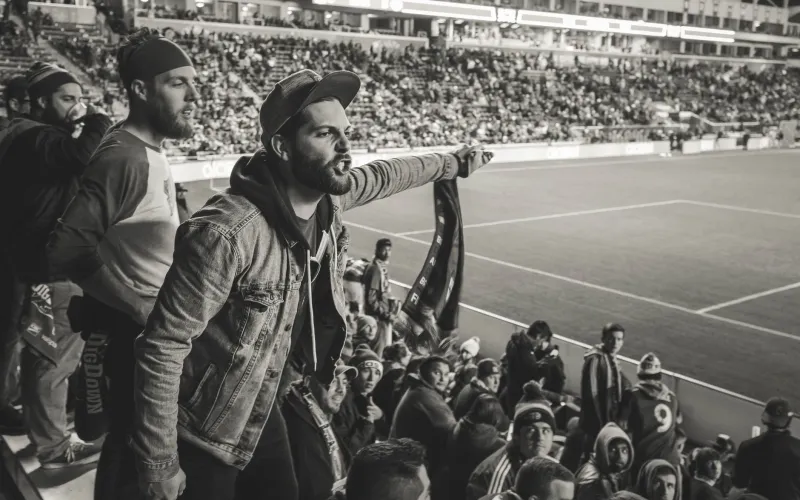
I want to tell you about a specific kind of Saturday.
It's the kind where you wake up slightly nervous for no logical reason, where the pre-game group chat is already buzzing before 9 a.m., where you wear the scarf even though it's 74 degrees outside because that's just what you do. It's the kind of Saturday that used to feel foreign to American soccer culture — something you'd read about from Anfield or the Allianz Arena, a ritual that belonged to other places and other fans.
That Saturday is happening right now, all over this country. And if you haven't felt it yet, you're going to.
The Bandwagon Is Empty
For a long time, the knock on American soccer fans was fair. We'd show up for a World Cup cycle, paint our faces, yell "I believe that we will win," and then quietly disappear back into football season once the tournament was over. We knew the superstars — Messi, Ronaldo, Mbappé — but couldn't name our local MLS club's starting goalkeeper. We were tourists in our own sport.
That narrative is getting harder to sustain.
MLS attendance has grown steadily. More importantly, the character of the crowds has changed. Walk into a Portland Timbers match at Providence Park, or an Austin FC home game at Q2 Stadium, or a Columbus Crew fixture at Lower.com Field, and what you'll find isn't a casual afternoon crowd. You'll find supporter sections that have developed their own chants, their own traditions, their own internal culture — the kind of thing that doesn't happen overnight and definitely doesn't happen by accident.
This is what genuine fandom looks like when it's being built from scratch, in real time, by real people who decided to give a damn.
Why Local Loyalty Hits Different
Here's something I think gets underappreciated in the broader conversation about American soccer growth: there's a fundamental difference between following a sport and belonging to a club.
Following a sport is passive. You consume it. You appreciate it. You might even love it.
Belonging to a club is something else entirely. It means your mood on Monday morning is tied to what happened Saturday afternoon. It means you have opinions about academy players nobody else has heard of yet. It means you argue about the manager's substitution decisions with strangers online at 11 p.m. because those decisions matter to you in a way that's almost irrational and completely wonderful.
American sports culture actually understands this concept deeply — we just haven't always applied it to soccer. Think about the way people in Green Bay talk about the Packers, or how Boston bleeds for the Red Sox. That's not just fandom. That's identity. That's community infrastructure. Soccer, with its 34-game MLS regular season, its promotion-and-relegation dreams, its continental cups and allocation drama, offers just as much material for that kind of emotional investment. Fans are figuring that out.
The Messiness Is the Point
One of the things that took me a while to appreciate about soccer fandom — real soccer fandom — is that it doesn't require your team to be good. In fact, some of the most passionate fan communities in the world are built around clubs that have never won anything significant.
That's a genuinely foreign concept in American sports culture, where we tend to follow success. We're a nation of frontrunners, and there's no shame in admitting it. But soccer fandom has a way of curing that instinct, because the sport is specifically designed to break your heart on a regular basis.
FC Cincinnati fans lived through years of lower-division obscurity and growing pains before the club found its footing in MLS. Inter Miami supporters have endured an ownership saga that reads like a telenovela. D.C. United's recent history is a polite way of saying "complicated." And yet the fans are still there, still loud, still wearing the jerseys.
That's not masochism. That's loyalty. And loyalty, forged through the bad times, is what turns a fan base into a community.
The Next Generation Is Already In
If you want to know where American soccer culture is heading, watch what's happening with kids right now.
Soccer is the most-played youth sport in the United States. Those kids are growing up with local MLS clubs as their teams — not Manchester City, not Real Madrid (okay, maybe also Real Madrid), but their teams. The ones whose games their parents take them to, whose jerseys they wear on picture day, whose players they know by name.
When those kids grow up, they're not going to need convincing to care about their local club. They're going to arrive at adulthood already invested, already loyal, already part of something. That's how you build multi-generational fan culture. That's how soccer in Europe got to where it is. It just takes time.
The timeline is compressing faster than most people expected.
What FootLove Knows
At the heart of everything that makes soccer special — the reason this sport has captured more of humanity than any other game ever invented — is the love of it. Not the trophies, not the transfer fees, not the television deals. The love.
The love of your colors. Your section. Your chants. Your club's ridiculous, infuriating, occasionally transcendent way of playing the game.
American soccer fans are finding that love at the local level, and it's changing the sport here in ways that no TV contract or marquee signing could accomplish on its own. The beautiful messiness of league loyalty — the heartbreak, the hope, the Saturday morning nerves — is no longer something we just read about from across the ocean.
It's ours now. And we're not giving it back.